The 2026 commercial real estate landscape in the Southeast has entered a definitive phase of recalibration. After years of interest rate volatility and price discovery, the market is shifting from "wait-and-see" to a period of disciplined execution. For investors active in Tennessee and the broader Southeast, the primary question has moved from "When will rates drop?" to "How do we value stability?" This Market Brief explores the stabilization of cap rates, the specific resilience of the Tennessee market, and why the flight to quality is the defining strategy of the year.
The Macro Shift: From Volatility to Velocity
As we move through 2026, the narrative surrounding investment sales commercial real estate has fundamentally changed. We are no longer chasing the valuation compression that defined the previous decade. Instead, the market is transitioning into a new cycle characterized by normalized pricing and disciplined underwriting.
Current data suggests that cap rates are largely stabilizing across the Southeast. While the previous 25 years saw a slow drift downward from 10% in the early 2000s to historic lows near 4-5% during the pandemic era, 2026 represents a "new baseline." We are seeing modest cap rate compression: forecasted at approximately 15 to 25 basis points for the year: but this is not a return to the "easy money" era. It is a reflection of pricing finally aligning with long-term fundamentals.
One of the most critical insights for 2026 is that debt supply availability is currently exerting more influence on cap rates than the absolute level of interest rates. The quantity of CRE mortgage debt flowing into the economy has become a more reliable predictor of cap rate movement than the 10-year Treasury. As liquidity returns: with investment activity expected to rise 16% to roughly $562 billion annually: investors are finding more transparency and certainty in their exit strategies.

Why the Southeast Remains a National Outlier
While the national outlook is one of stabilization, the commercial real estate Southeast region continues to outperform historical averages. Tennessee, in particular, has emerged as a primary destination for both institutional and private capital.
Several factors contribute to this regional resilience:
- Net Migration Patterns: The Southeast continues to capture the lion’s share of domestic migration, supporting demand in multi-family and necessity-based retail.
- Employment Diversification: Markets like Nashville, Memphis, and the surrounding corridors are no longer dependent on a single industry. The growth in healthcare, logistics, and tech provides a safety net for property owners.
- Pro-Business Climate: Low state taxes and a favorable regulatory environment reduce the "friction" of ownership, which is a significant factor in cap rate compression for local assets.
When looking at commercial real estate Tennessee, we see a market where the "spread" between the risk-free rate and cap rates is finally reaching a healthy equilibrium. This makes the region particularly attractive for 1031 exchange buyers coming from high-cost, high-regulation states.
Sector Breakdown: The "Flight to Quality"
In 2026, we are witnessing a distinct bifurcation in the market. There is no longer a "rising tide lifts all boats" scenario. Instead, there is a intense "flight to quality" in the industrial and retail sectors.
Tennessee Industrial Real Estate: Demand Meets Discipline
The industrial sector remains a powerhouse, though the focus has shifted toward functionality and "future-proofing." Investors are prioritizing assets with high clear heights, ample dock doors, and proximity to major logistics hubs. In our previous deep dive on Tennessee Industrial Real Estate 101, we noted that the $8–$11/SF range has become a critical benchmark for the region.
In 2026, industrial cap rates are showing the most stability due to the continued growth of e-commerce and the regionalization of supply chains. While supply has caught up to demand in some submarkets, the inherent "mission-critical" nature of these assets keeps cap rates tight compared to other asset classes.
Retail: The Return of the Necessity-Based Asset
Necessity-based retail: grocer-anchored centers and unanchored strip centers with strong service-oriented tenants: has become a darling for Southeast investors. These assets offer "income durability," a key theme for 2026. Investors are prioritizing predictability of Net Operating Income (NOI) over speculative rent growth.
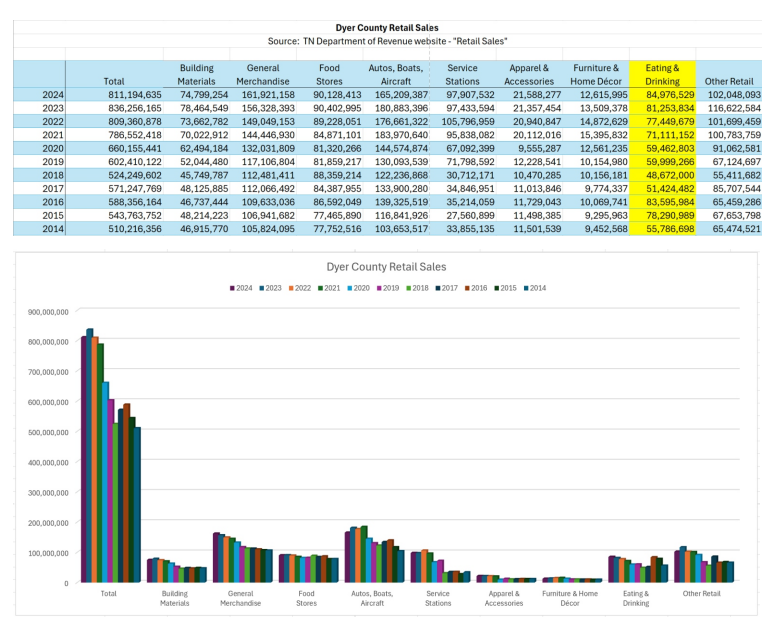
As shown in the data above for Dyer County, consistent annual growth in retail sales (reaching $811M in 2024) provides the fundamental "proof of concept" that Southeast investors need. When retail sales grow year-over-year across sectors like eating/drinking and general merchandise, the underlying real estate gains a level of security that office assets currently lack.
Multi-Family Investment Southeast: Navigating the Supply Wave
The multi-family investment Southeast sector is facing a unique set of circumstances in 2026. While the region saw a massive influx of new supply over the last 24 months, the market is beginning to absorb these units thanks to continued population growth.
A major tailwind for 2026 is the increase in debt capital availability for the multi-family sector. Government-sponsored enterprises (GSEs) like Fannie Mae and Freddie Mac have received an approximate 20.5% increase to their lending caps this year. This influx of liquidity is helping to floor cap rates in the multi-family space, preventing the dramatic expansion that some analysts feared.
However, the "bidding wars" of 2021 are gone. Today's multi-family investors are focusing on:
- Contractual Rent Escalations: Ensuring the lease structure can keep pace with inflation.
- Expense Management: With insurance costs and property taxes rising across the Southeast, efficient property management has become the primary driver of value.
- Location Grade: Class A assets in high-growth submarkets are seeing cap rate stabilization, while Class C assets in stagnant areas are still facing upward pressure.

Underwriting for 2026: The New Rules of Engagement
To succeed in the current market, investors must move beyond the "pro-forma" mindset and look at the hard data. At Buchanan Realty Group, we are seeing three major trends in how the most successful deals are being structured this year:
1. Focus on Income Durability
Investors are no longer buying based on the "hope" of future rent increases. Instead, they are looking for "sticky" tenants with high build-out costs or essential-use characteristics. If a tenant is unlikely to move because their specialized equipment or local customer base is too valuable to leave, that income stream is valued at a premium.
2. The Debt Coverage Ratio (DCR) is King
While cap rates are the headline number, the DCR is the operational reality. With interest rates remaining elevated relative to the 2010s, ensuring that the property can comfortably service its debt while maintaining a capital reserve is paramount. We are seeing more "all-cash" or high-equity deals in the Southeast as investors prioritize safety over leverage.
3. Local Expertise is Non-Negotiable
In a stabilizing market, the "average" no longer exists. One block can have a 6% cap rate while the next block faces a 7.5% cap rate due to local zoning, traffic patterns, or tenant health. Working with a team that understands the micro-markets of Tennessee is essential. Whether you are looking at current listings or evaluating a long-term development, the nuances of the local landscape are where the alpha is found.
Final Thoughts: The Road Ahead
Are cap rates stabilizing? The answer is a resounding yes: but with caveats. The "easy" gains from cap rate compression are behind us. The gains in 2026 and beyond will come from operational excellence, strategic site selection, and an intimate understanding of the Southeast's unique economic drivers.
The Southeast remains the most resilient region in the country for commercial real estate investment. By focusing on quality assets, durable income, and realistic underwriting, investors can find significant opportunities in this new cycle of stability.
Ready to explore the Tennessee market?
View our current listings or connect with our team to discuss your 2026 investment strategy.
- Brandon Buchanan: View Profile
- Keaton Dotson: View Profile
- Matt Wright: View Profile
This Market Brief is part of our ongoing commitment to providing actionable insights for Southeast CRE investors. For more updates, visit the BRG Market Brief section of our website.